

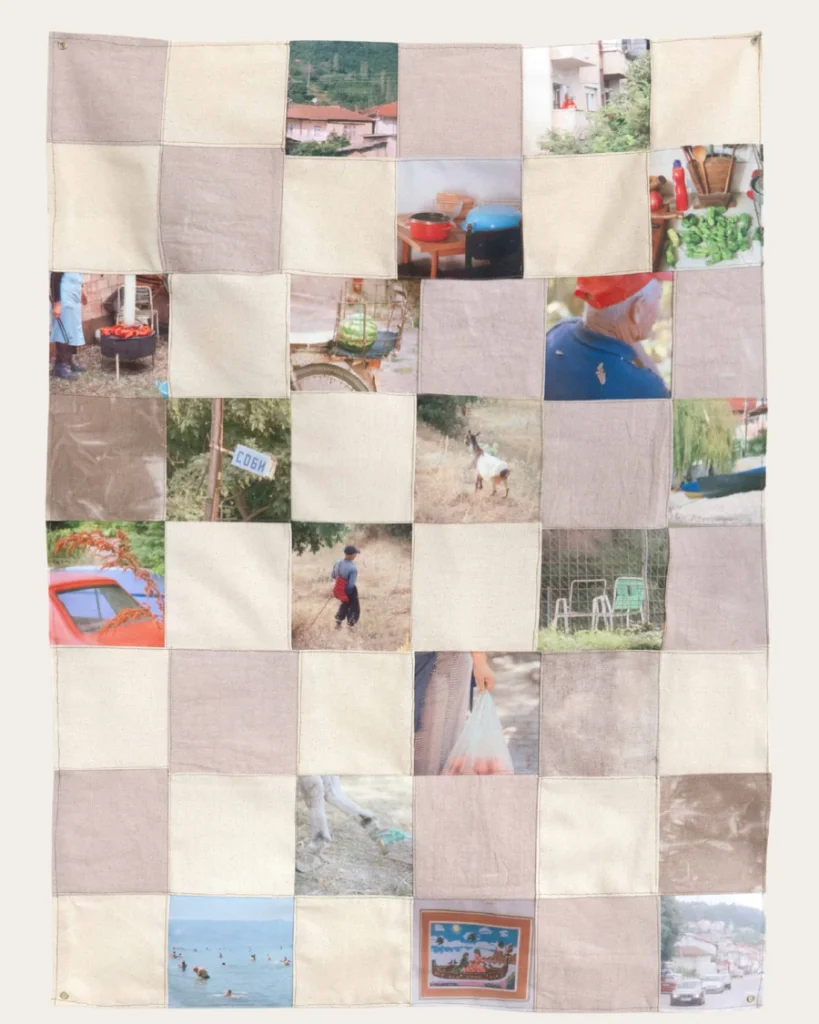
A photograph, to Nathalie, is not a finished image to be framed and kept but a material: to be printed, cut, stitched, and built with. Shooting on film and printing her pictures onto cloth, Nathalie sews, by hand and by machine, the photographs into quilted surfaces of found denim, old bedsheets and curtains. Photography rebuilt as textile.
Dutch-Macedonian artist Nathalie Basoski trained first as a photographer, studying film and photography at the Pratt Institute in New York. Years later, alone in her first studio, she pushed a needle and thread through one of her own photographs simply to see what would happen. The practice has grown from that small tactility ever since.
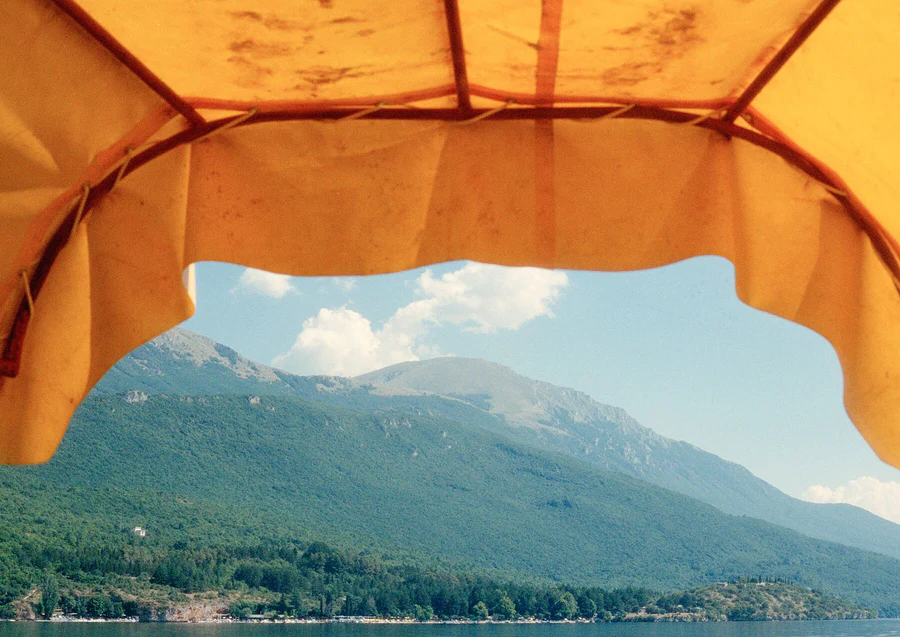
Today her work moves across photography, textile and installation, with memory, heritage and belonging at its centre. Much of it begins each summer in Macedonia, where she returns to the place she is from and photographs without developing a single roll. As she calls it, ‘harvesting’, a season she then spends the rest of the year in New York slowly developing, scanning and stitching into finished pieces. The same journey, taken again and again, never yields the same image twice.
In Return to Sender, the photograph sheds its status as document and becomes something closer to correspondence: pictures Nathalie once dismissed as failures, reopened years later and found to be exactly right. An image taken by who she was, addressed to who she would become. Working in the lineage of the Gee’s Bend quilters in Alabama, she prizes cloth that has already lived, setting the patina of used fabric against the patina of film. Exhibiting through Partnership Editions and through her solo show Let The Grass Grow at Reform Architecture Gallery, Nathalie treats each piece less as a finished object than as one more entry in an archive she is never quite done with.
We speak about photographs written off and later redeemed, cloth that arrives already full of other lives, the ritual of going home each year to gather images, and why, in her hands, a photograph is never really finished.
You trained as a photographer. I’d love to understand how you came to work across both textiles and photography, and the lineage behind that.
I did study photography: film and photography, though I ended up leaning more into photo. It really happened by chance at the art school I went to in New York. I had a friend who was printing her photos onto textiles, onto canvas, and I was like, wow, that’s crazy, I’d never thought of it. In my photo classes we were printing on paper, learning all the technicalities, and it’s stressful because the paper creases and marks and gets damaged. That’s the whole science of it. But printing on textile seemed insane to me in the best way. So cool.
So for a while I was just a photographer whose photos happened to be on textile. They’d hang, and because everything I shoot is on film, it was lovely to see the grain and the texture living in the fibres, the way they move.
Then a couple of years ago I got my first studio and started doing some simple hand-stitching, just for the fun of getting a needle and thread to go through my photos. That was mind-blowing to me. I’d done collage before, ripping paper, but pushing a needle through a photograph felt like something else entirely. It’s still exciting to me.
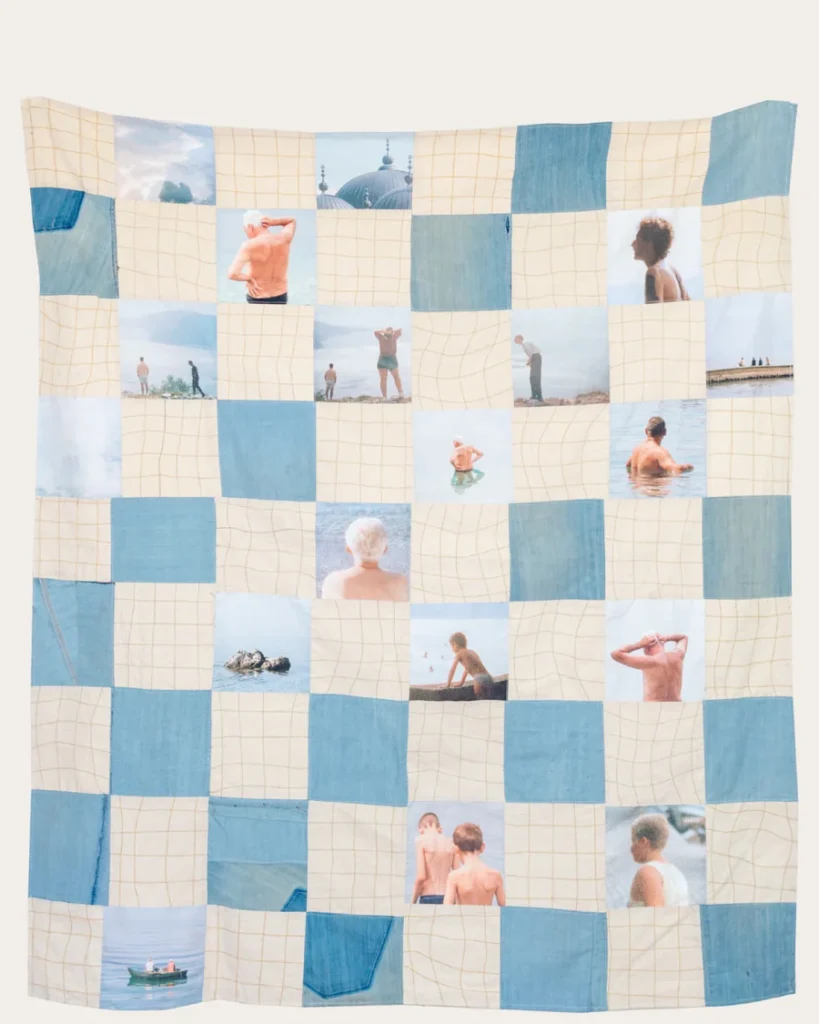
My hand-sewing was slow and not that great, so I got a sewing machine, and after that it was off to the races. I learned a basic patchwork technique: cutting and sewing, building flat collaged surfaces. I started using photos I already had on canvas alongside denim jeans, bed sheets, curtains, whatever fabrics I had around. It opened something up in my brain: combining these materials that are so ordinary we barely think about them and placing those textures and colours and weaves next to a photograph so they complement or contrast each other. That exploration and curiosity is still where I find so much satisfaction every time I make work.
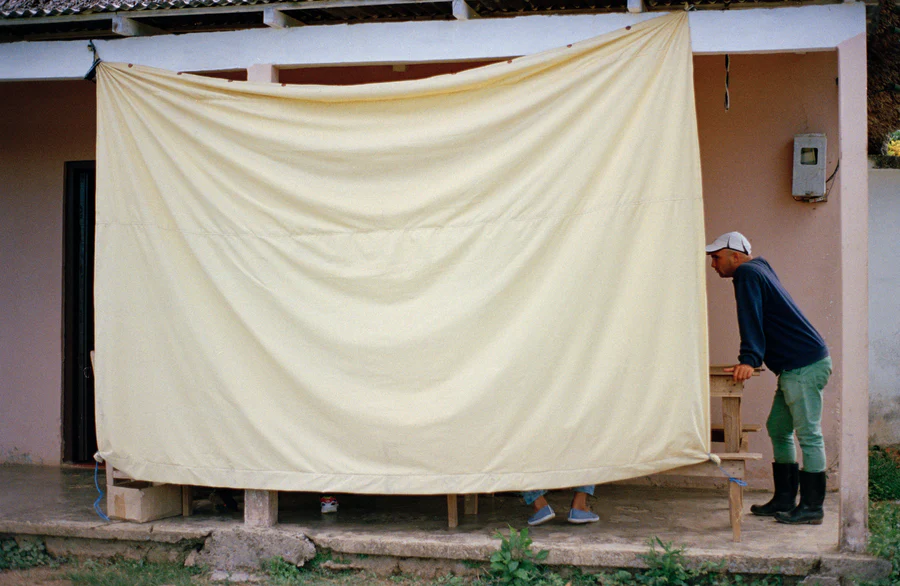
I was getting inspired by the Gee’s Bend quilts: the community of women quilters in the American South who make quilts by hand out of leftover materials, a lot of denim, random bed sheets. I love that you can see they’re old and worn and stained. You can see where a pocket used to be on a piece of denim, that whole previous life.
That’s what excites me: textiles that have already lived, combined with photography, which for me is a very archival thing. Most of my personal work is intuitive and in the moment. I don’t stage anything, it’s documentary, my surroundings, my family, where I’m from in Macedonia. So you get that nostalgic feeling from a photo, especially shot on film, meeting the patina of a used textile. It’s been such an exciting thing to explore.
You work with so many found materials. Is there a process you follow when gathering them or working with them?
I have big plastic containers of fabric in the studio: things that were free, given to me, or found on the street. In terms of selection, I like natural fibres. Sometimes polyester, but nothing too stretchy or too crazy. I like when something is a bit worn or damaged. A bed sheet that’s been rained on, the kind of watermark you get from that.
I used to think, just take everything, you never know what you’ll end up using, which is sort of true. But after doing this for over five years I can see a clear pattern in what I will and won’t use. The materials in my studio are very specific; they’re descriptive of what I like and who I am.
I realised this recently teaching my first workshop at a gallery. I provided the printed photographs on textile, and the gallery provided scrap fabric, textile samples from the fashion industry. When I got there and saw the materials, I thought, I would never choose these for my own work. A lot of thin, oddly textured stuff I couldn’t work with. But it worked well for the workshop, because the participants were making their own pieces and choosing for themselves: so nobody ended up making work exactly like mine, because they weren’t sourcing the same scraps.
It reminded me not to say “never,” though. Sometimes I look at a material and think I have no idea what to do with this, and then two years later there’s suddenly a need for it. So I try to stay open-minded.

One of your pieces, I Followed Them to Athens, feels like it’s about ritual and memory. Are there rituals from your upbringing that you bring into your work?
The real ritual for me is my workflow, which repeats every year.
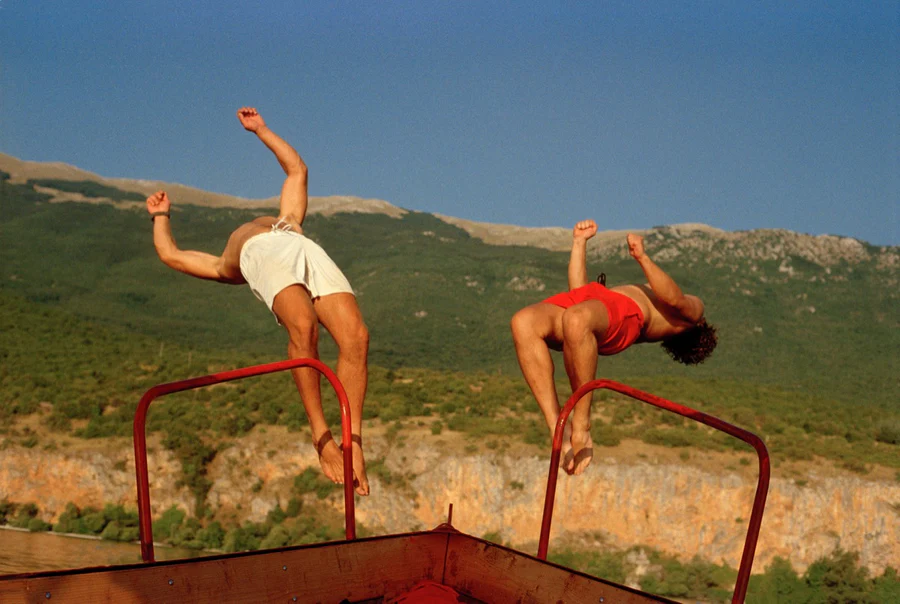
I go home to Macedonia every summer and spend one or two months there. I shoot everything on film and don’t get to see any of it until I return. So I think of it as harvesting: I’m there collecting moments, life experiences, this place I miss all year. My family is there. I’m trying to hold onto what it felt like as a teenager when I lived there, even as the place keeps growing and evolving without me. I’m just there to capture a year of it.
Then I come back to New York and develop and scan the film, which takes another month or two. I end up with maybe three, four, five hundred photos depending on how much I shot, and I spend the whole year curating that archive: combining it with older photos, getting prints made on fabric, making pieces. That’s my way of digesting the trip. And then it comes back around and I go again.
It’s an interesting practice, taking essentially the same trip every year and coming back with different photos, or the same photos, but something will have changed. The place changes; I change; who I am changes. I actually started taking photos there when I was fifteen. My family recently renovated my childhood home, which I’m genuinely upset about because I loved how it looked when I lived there.
I Followed Them to Athens is literally me following my parents to Athens. I did make it to Macedonia last year, just not in summer. I ended up going in October, once the season had ended. It was raining and cold, and my parents always take a little trip to Greece after summer, so I said, “I’m coming with you, because it’s probably sunny there.” They said, “Okay, we love you, you’re our daughter, we might get annoyed with each other, but come.” The older I get, the less often that happens: twenty-four, forty-eight, seventy-two hours of just being with my parents. I took all of that in with the camera, brought it back to New York, and made those works.

That leads perfectly into the body of work: Return to Sender. Is that about going back into your archive? And do you see it developing, continuing to compare your new photos to older ones?
Yes, I go back into my archive, mostly sticking to the film photos because of that separation I have between taking them and finally seeing them. I’ve been shooting film for about ten years now. Sometimes I’m just bored and I’ll pull up my 2018 summer photos from Macedonia. Even though I’ve looked at them hundreds of times, I always tell people, of these two rolls there were six good photos, two amazing ones, and the rest didn’t work. I’ll go back eight years later and think, actually, this one blurry photo I wrote off as trash is perfect for where I am now. At the time I wanted a specific thing and it didn’t work, so I dismissed it. But now, mentally and creatively, I have a vision for it I didn’t have before.
That’s the Return to Sender idea: my past self took a photo for my future self to receive: to eventually say, thank you, I really appreciate this, whenever and wherever it arrives in my life. I might take pictures this summer and come home disappointed that a moment didn’t come out how I wanted, and then ten years from now realise that missed moment is fine, because there’s something else in the photo that’s really great.
I try to stay very open-minded with the archive. It’s human nature to look back at your past self and think, I’m more evolved now, I have better style, I know better: you see an old photo of yourself and cringe at the shirt you were wearing. But my photographs are the one place I don’t feel that. I can look at anything in the archive and still admire it, still find it useful. I’m gracious with myself there. The work keeps serving me one way or another; I just keep developing, and I see potential I couldn’t see at the time.
Do you find the same is true of your textiles, that they’ll keep evolving with your photography, or is that more separate?
I judge the textiles a bit differently. A photo is I captured this moment: it takes technical skill, but it’s also very much down to the surroundings. With textiles, I’m making creative decisions, and there I do sometimes feel I’m so much better now, because I consider a textile piece finished. Occasionally I’ll take a work apart and reuse it for something else, but generally, once I’ve stretched it and photographed it, that’s a piece. And then I might look at it and think, I thought this was done, but I feel like I could do better now.
Whereas with photography, the photos feel more like ingredients, I just have to find the potential in how to use them. They’re not in a final, decided form.
Do you have any favourite pieces?
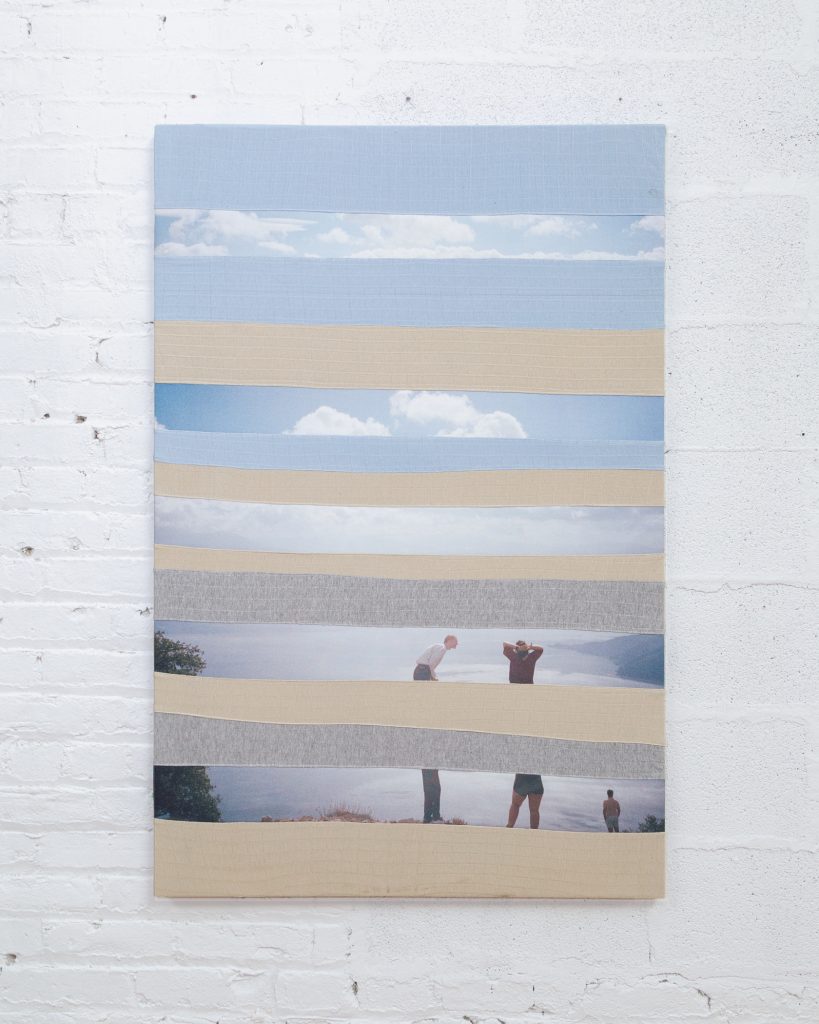
My most recent ones. I’m trying something different, working with motion; using silk organza, which is very light and airy, so when I hang it in front of a work it starts to move. I think that’s really cool. But I don’t want to throw you off, because that work is unpublished and unrelated to what you’ve been able to see.
Otherwise, I recently had a solo exhibition in New York [Let The Grass Grow at Reform Architecture], and I really love the works in that show. There are a couple where I think, past me would have been so proud and excited to make these.
From a craftsmanship and art perspective, beyond the Gee’s Bend quilters, who or what influences your work?
Lots of things. In an on-the-nose way, I’m very influenced by other textile artists and photographers. But nothing inspires me quite like seeing someone use techniques or ways of thinking close to mine, because that makes me go, oh, I can do this, I want to try this.
There’s an English artist I really like whose work is similar to mine, Lawrence Calver. He does not use photos, but big pieces made of random found materials in composition, which are always inspiring.
I’ve also met textile artists who’ve become friends, including one who’s about to start working with Partnership Editions. She works with textiles too, called Ruba Nadar. What I love is that people doing similar things understand my thought process and the excitement of it: printing onto a strange material, stapling something in, the stitches.
Is there a piece, a curtain, or an item of clothing, whether for your art or for yourself, that you didn’t pick up and still regret?
Not really. I almost never buy fabric. Occasionally something on eBay, but I don’t really go to fabric stores. Most of it is free, from the street, or passed on to me. I can’t think of a regret about something I didn’t get.
I’d love to stumble on some abandoned building with a big tarp that’s been painted on, that kind of thing. But I haven’t come across it yet.
If someone visited you in New York for a day, where would you take them: a gallery, a café, a restaurant?
For food, Spicy Village in Chinatown, Manhattan. A proper hole-in-the-wall: tiny, cash only, pretty cheap, originally just a spot for local Chinese people to grab lunch and go. It got written up in a few magazines as some of the best food, but they’ve never tried to upgrade it.
For galleries I couldn’t pick just one, I’d walk around the Chinatown galleries in Manhattan. There’s a whole area of former businesses turned into galleries, and the work there is often something I relate to more than in other neighbourhoods.
For coffee: I don’t really drink coffee, but there’s Rita & Marie close to my studio in Brooklyn, they have really good tea. The chairs are all mismatched, like they came from an old school: not necessarily comfortable, but I get the vision. There are always interesting, artsy people there with good style, in a non-pretentious way.
Find Nathalie’s portfolio: NATHALIE BASOSKI
Cover Image: Postmarked for Tomorrow, 2026 (Part of Return to Sender)
Leave a Reply