
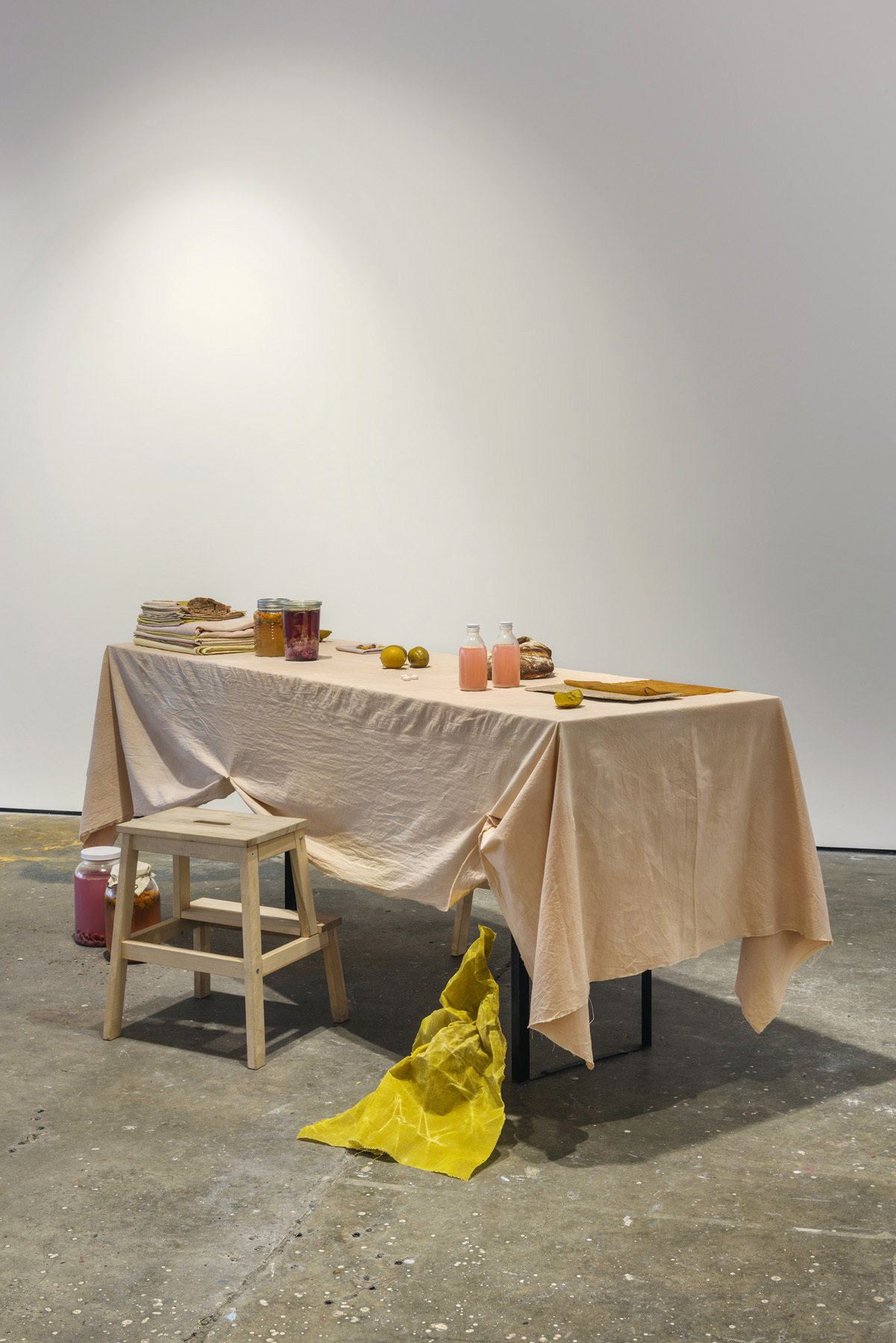
Feature photograph: Unit 1 Gallery | Workshop
For Inês Neto dos Santos, food is not just sustenance, or even culture, but the very material through which the world is constructed.
Born in Lisbon and based between London and Brussels, dos Santos studied Graphic Design and Illustration at London College of Communication, before completing an MA in Visual Communication at the Royal College of Art in 2016. Her practice moves between performance, installation, and social sculpture, but food runs through all of it: not as subject matter alone, but as a framework for understanding ecology, collaboration, and the invisible labour embedded in everyday life.
Her works are as much about what is carried as what is made. Sourdough Jacket (2022) and Yoghurt Jacket (2023) are wearable sculptures lined with dried fermented starters, inspired by the stories of migrants and travellers who preserved living ferments in scraps of cloth. The yoghurt lining for Yoghurt Jacket arrived on a piece of cotton sent by a friend, cut from his grandmother’s ironing cloth. In Friends Who Ferment (2023), a quilted piece assembled from fermented textile patches sent by friends and strangers from across the world, fermentation becomes a way of mapping connection.
Beans occupy an equally central place in her thinking. In Cantemos o Feijão (2022), performed at an agroforest in Alentejo, audiences were invited to collectively peel and mash beans together, accompanied by Cante Alentejano, the traditional folk singing of agricultural workers. An act of shared labour that dissolved the boundary between nature and culture, past and present.
dos Santos expands on her artistic practice as co-director of The Gramounce, an organisation that reconceptualises the world through food, establishing it as a legitimate artistic and intellectual discipline and a foundational force in any world-building exercise; bringing these ideas to life through courses, collaborative projects, critical publications, and interventions that challenge the boundaries of how food is understood in culture, aesthetics, and ecology.
We speak about sourdough carried across borders, the quiet power of beans (even better when fermented), and how food became the lens through which to see the world.
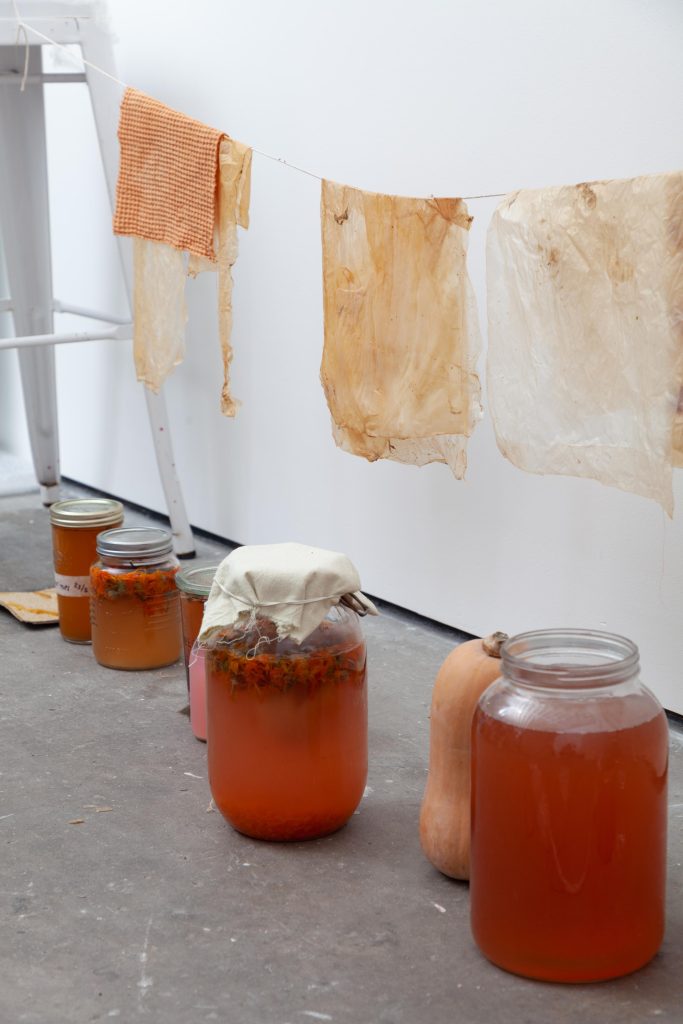
Unfurling, 2022
Photograph by Unit 1 Gallery | Workshop
Food sits at the centre of your practice, but do you remember the first meal or kitchen moment that made you realise it could also be art?
I’m not sure it was such a clear click, but I remember, during the final year of my BA at LCC in London, discovering the concept of “food design” and the work of Marije Volgezhang. It was enlightening to see food not just at the hands of a chef, but in the world of a designer — at the time I was studying Graphic Design and Illustration.
You’ve spent recent years working with fermentation: both practically and metaphorically. What does fermentation allow you to explore that other materials or processes do not?
Fermentation has been a gateway into deconstructing my own humanness as just a small piece of a multispecies web. It serves as this portal that allows for an understanding of time as a very deep and winding concept, stretching far into the past and future but holding us in the present.
More recently, your research has turned toward beans and their soil-regenerating qualities. What drew you to beans specifically?
I was fascinated to learn that beans (legumes) are one the few plant families which can absorb atmospheric nitrogen and, through a collaborative process with soil bacteria, transform it into soil-based nitrogen. This is a substance that is fundamental for the growth and life of any plant — wherever beans are planted, they make this nitrogen available not just for themselves but for all surrounding plants too. This spoke to me about co-resilience, collaborative living and the blurring of boundaries between where one life begins and another ends.
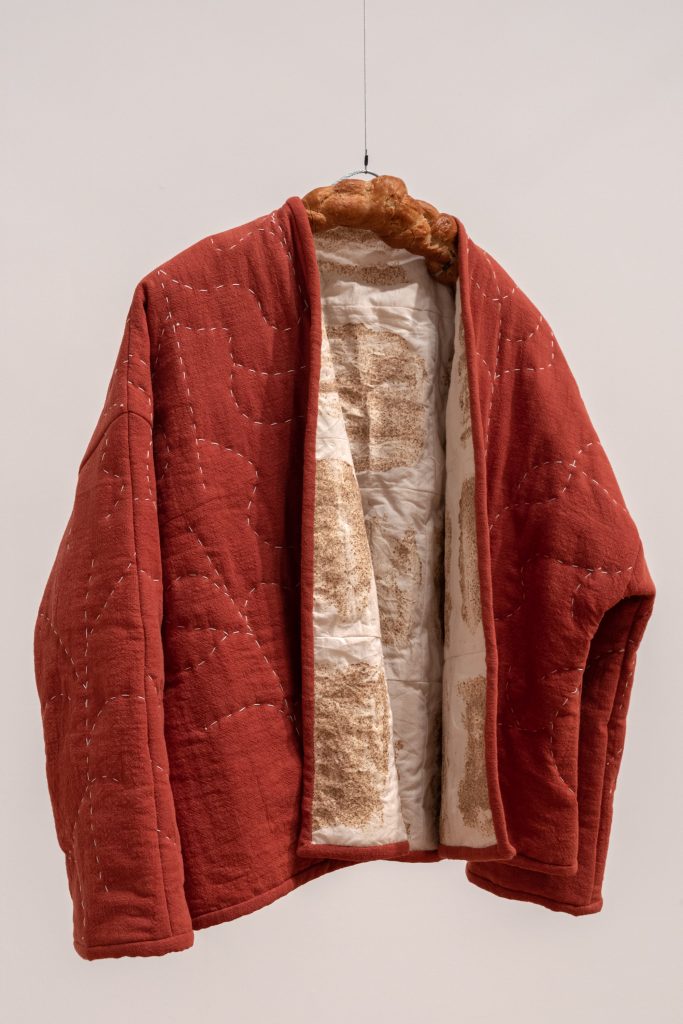
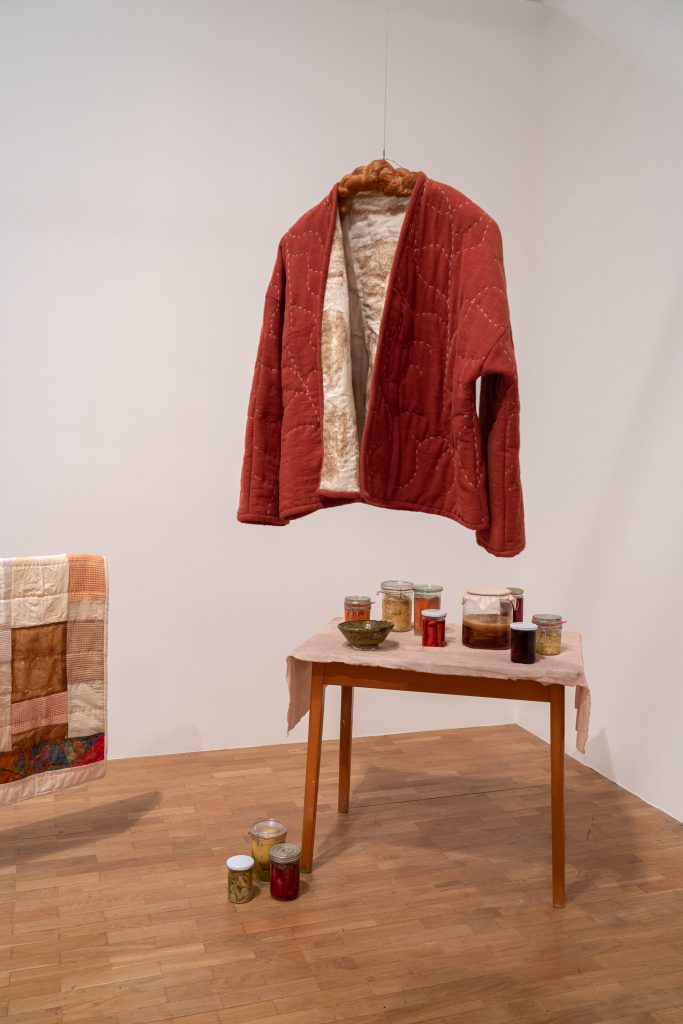
Sourdough Jacket, 2022
Photographs by Sam Nightingale
In Sourdough Jacket, you transform dormant sourdough starter into a wearable sculpture inspired by migrants carrying dry ferments. What drew you to make fermentation something that could be worn, and how does its cyclical renewal relate to migration and continuity?
Sourdough Jacket and all its accompanying pieces are inspired by stories of migrants and travellers moving across borders with fermented starters applied to fabric, as a way to preserve them (by drying, on textile). These dry ferments can be transported easily, unnoticed, in someone’s pocket or luggage. They can then be reawakened wherever the person carrying them settles – often by mixing in a warm liquid. Placing dry sourdough on the inside of a warm jacket was a way to share these stories and speak of the power of transgressing borders, carrying dormant life and nourishment close to one’s body, carrying a sense of home from one place to another. These fermented cloths may look simply dirty to unknowing eyes, but in fact they contain a whole world: family stories and histories, familiar flavours and a connection to home. They can be revived and multiplied, to feed the traveller but also everyone around them.
The kitchen and domestic space frequently appear in your thinking. How do you understand these spaces in relation to authorship and artistic labour?
The kitchen and any domestic space centres invisible labour, care work that is hidden and mostly unvalued by society, particularly under capitalist and patriarchal terms. I am interested in what happens in this spaces, what stories dwell there and how they are shared and told — and inevitably, how they connect us to the whole world and each other, whether human or more-than.
Through projects like Mesa and Food Cosmogonies, you position food as central to world-making. What does it mean to think cosmologically through food?
Through those projects and generally through the organisation I co-direct, The Gramounce, we see the world through food. We understand the world as an entity made of food, where food is a crucial and fundamental building block. This is what means to think cosmologically about food – to see it as the material which makes us who we are and builds our surroundings.
Who is one artist that inspires you within your practice?
It’s so hard to pin down one artist, but recently I have been so inspired by Veronica Ryan.
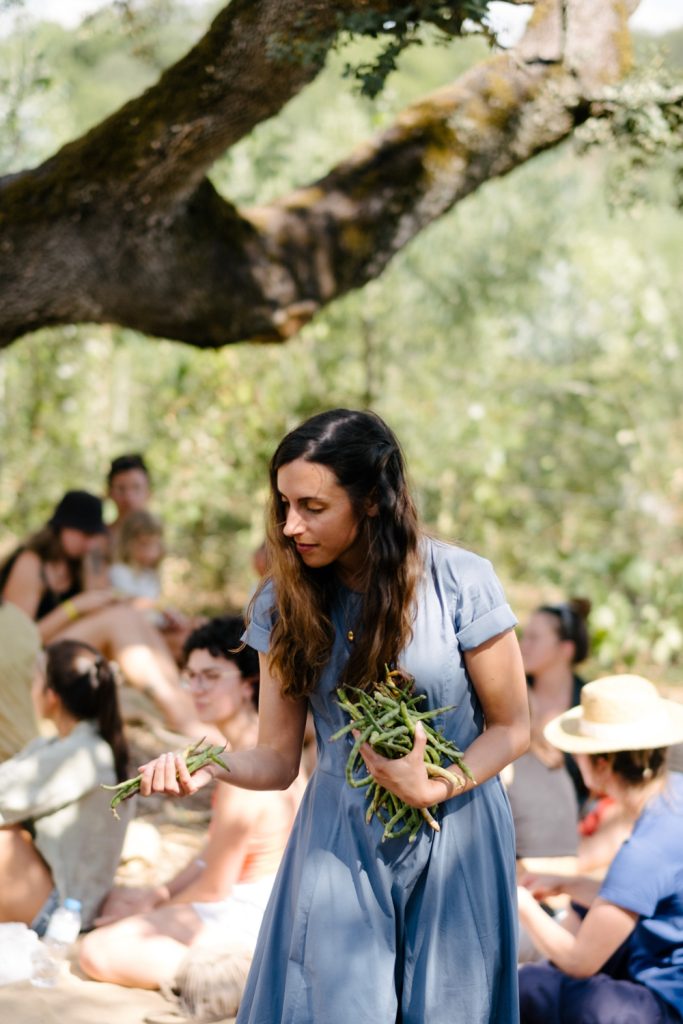
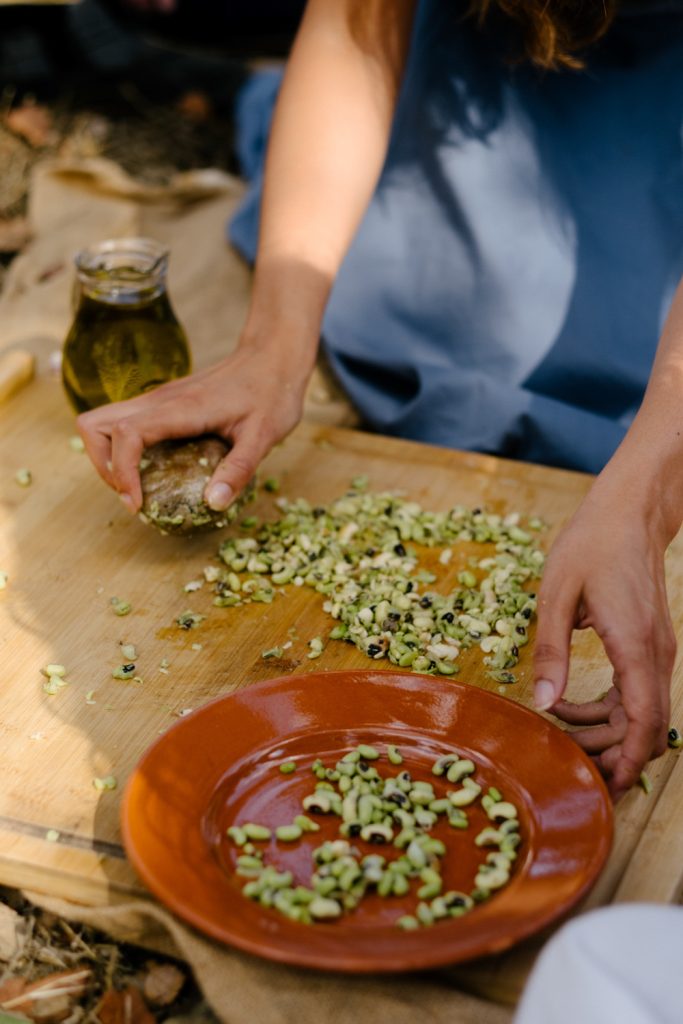
Cantemos o feijão, 2022
Photographs by Vera Marmelo
If you were to introduce someone to your work through a single dish or ingredient, what would it be, and why? (If there is a recipe attached, I would love to know!)
Probably beans! And bread! And something fermented on top.
What are five food items that are always in your kitchen?
Bread and butter, salt, olive oil, onions and garlic. Probably my basic necessities!
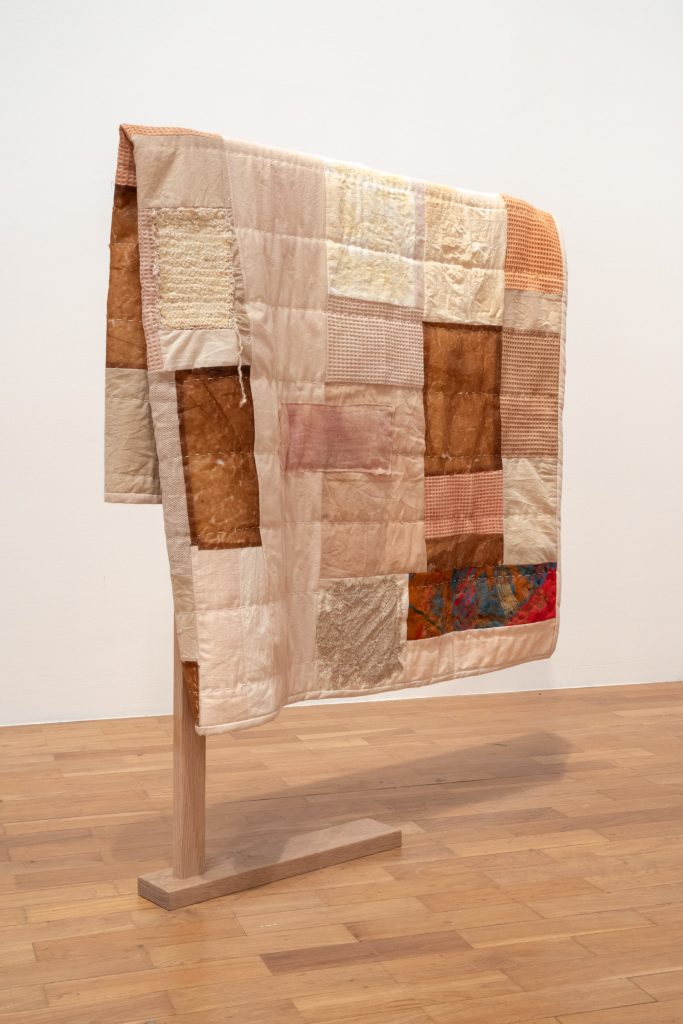
Friends Who Ferment, 2022
Photograph by Sam Nightingale
Leave a Reply