

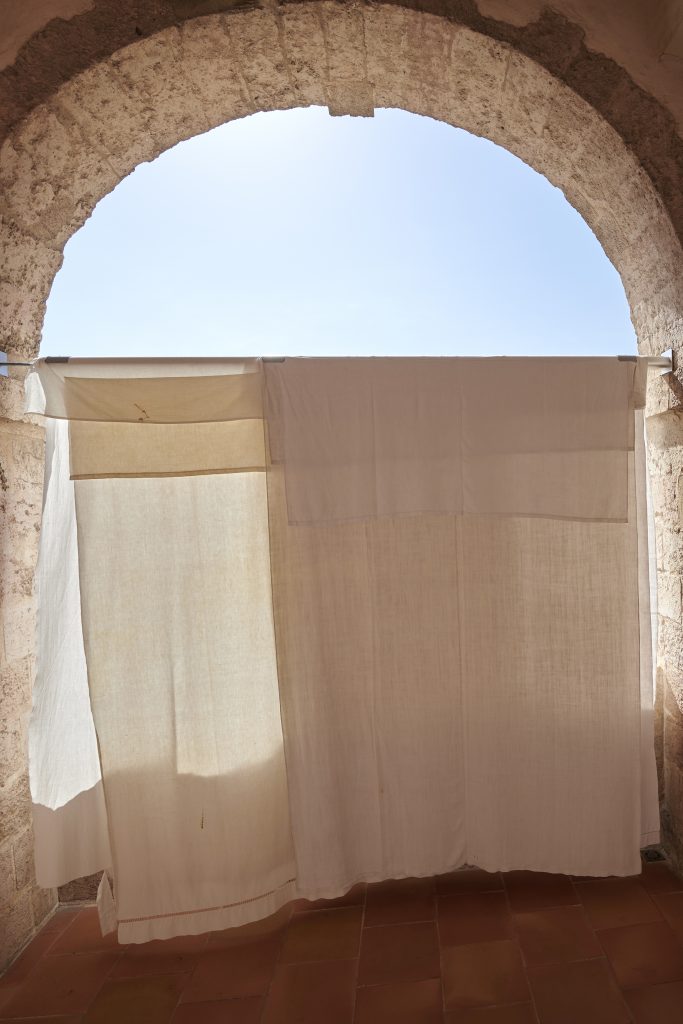
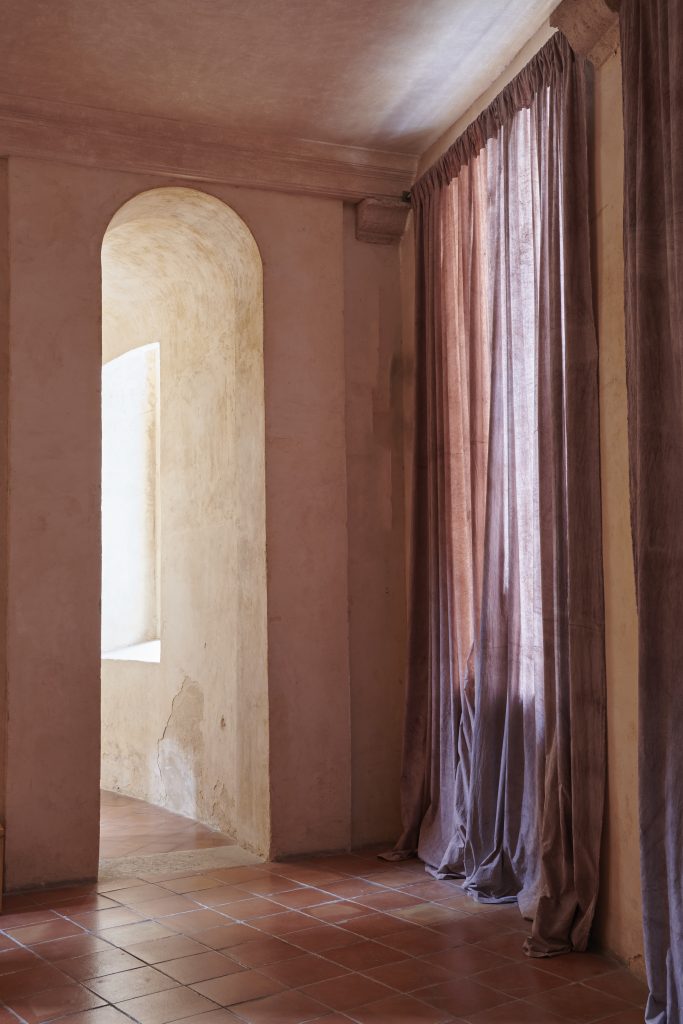
Tucked into Marseille’s Le Panier district is one of this summer’s most popular exhibitions, and arguably its most Instagrammable. For Dormir comme le soleil, Adrien Vescovi has hung La Vieille Charité with more than six hundred antique bed sheets: old linen and thick cotton, some still carrying a previous owner’s embroidered monogram or a mended tear.
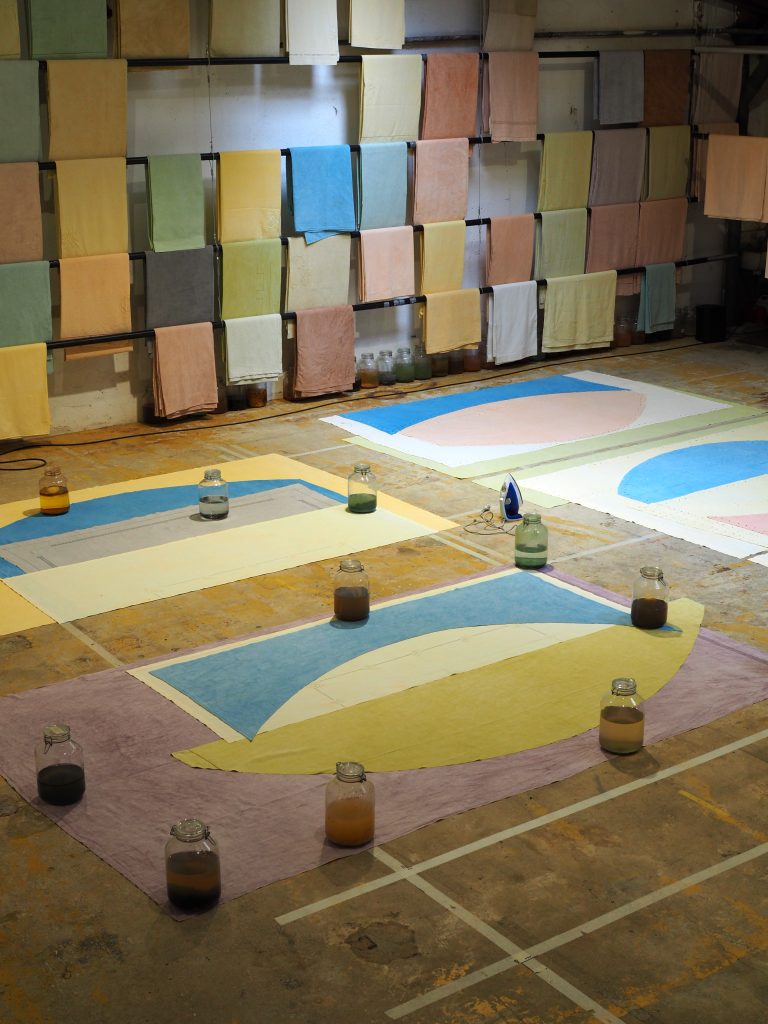
The dyes he uses, whether plant decoctions from Savoy or ochres he collects around Marseille and in Morocco, never set permanently. Vescovi trained as a painter and still reads materials like one. Arriving somewhere new, he walks and looks before anything else, at the soil, the plants, the buildings, many of them in Marseille rendered in the same ochres he dyes with. But he tends to describe the work more like a cook than a studio painter: each shade goes into a notebook he keeps as a diary rather than a recipe to be repeated, judged by smell, temperature and intuition as much as by measurement.
He works slowly by choice, and is wary of the word ‘sustainability.’ For him it comes down to using what is already there, taking only what he needs, and not hurrying the process. For this exhibition he’s debuting a cold-dyeing method that leaves the pigments free to keep reacting to light, humidity and temperature: so a cloth looks different at the end of the show’s eight-month run than it did at the start, and the mistral’s movement becomes part of the work itself.
The contradiction doesn’t seem to bother him: a body of work about patience and slow change has spread quickly online, and nowhere faster than in Marseille, a city now often talked about as the East London of France. If catching the fabrics on a screen sends someone to look longer at the real thing, he says, the work has done what it should.

Your dyes often come from the land you’re working on: plant decoctions in Savoy, ochres you collect around Marseille and in Morocco. When you move somewhere new, what are you looking for first?
When I arrive in a new place, I start by walking, observing. I pay attention to the soil, to the plants, but also to the city itself. Here in Marseille, for example, I’ve become very attentive to the colours of the walls. Many of them are made with ochres, the same pigments I use. So for me, the urban skin becomes part of the palette.
In Dormir comme le soleil, you record each new shade as you blend it in recipe books, and the colour shifts from one dye bath to the next by half-tones. Does the language of the kitchen describe the work more accurately than the language of the studio, and to what degree do you feel that you’re almost ‘cooking’ with the dyes themselves?
Cooking is actually a fair word. Even if the processes are precise, it’s about smell, temperature, intuition, and accepting that things will shift. My notebooks are not instructions for repeating, they’re closer to a diary, a way of remembering what happened once, not a way to standardise.


Much of the material is antique bed sheets, more than six hundred of them, some still carrying a previous owner’s embroidered monogram. What do you look for in a sheet before you use it, and do the details change how you handle it?
I’m drawn to these sheets for two main reasons. First, the material itself: old linen or thick cotton, fabrics with a density and quality of craftsmanship. They have a presence, a weight, that I relate to as a painter. And then there’s what they’ve lived through. A monogram, a mend, a trace of someone. I’m interested in that quiet history. I don’t romanticise it, but I don’t erase it either. It’s something I let speak within the work.

For this exhibition you debut a cold-dyeing technique that lets the pigments keep evolving, so the fabrics go on changing after they leave your hands. What made you want a colour that never quite settles? How will the climate across the eight-month exhibition run work with the dyes themselves?
I wanted colour to remain alive rather than fixed at a single moment. With cold dyeing, pigments continue to react to light, humidity, temperature. Things keep moving, and I find that much more interesting than preserving a fixed image. This is also connected to the way I produce colour. Depending on the pigments, Ocre or plants, I move between heated dye baths and cold processes. It’s also about being attentive to energy, water, and material consumption. I’m interested in using only what’s necessary and letting the material reveal its own potential rather than forcing it.
A lot of the focus on your work is slow and reclaimed: natural dyes, found sheets, cloth reworked over years, the weather manipulating the colour. Sustainability and craft are words attached to a lot of art now, often loosely. What do they actually mean in your practice, day to day?
’Sustainability’ is a word I use cautiously. For me it’s a daily ethic. It means working with what’s already there, being attentive to resources, using natural pigments, producing only what’s necessary, letting things take the time they need. It’s just how I try to work.

Dormir comme le soleil has travelled widely online, despite the focus being on slowness, ageing, and fabric changing over months. What do you make of a piece about patience finding an audience through a medium built for speed? Did you expect it to reach people this way?
Slowness is an ethical position for me. In a world that values speed and constant production, I’m interested in defending another rhythm. Taking to observe, to let things evolve feels like a way of resisting that pressure.
At the same time, I use the tools we all use today. What I like is the tension: something made slowly can travel very fast as an image. If that quick encounter makes someone pause longer later, then it’s doing its job.
Finally, your relationship with Marseille. If you were showing someone the city for a day, where would you take them: a restaurant, a gallery, a café, and somewhere for an aperitif?
My relationship with Marseille began much earlier than 2017, during a residency at Triangle France in 2009. I stayed almost five months and file good with the city. When I left, I had the feeling I hadn’t finished my story here. Moving back in 2017 was a way to continue that conversation.
Today, my life is intense and I need to organise time. It revolves around the studio. Long days working, a break for coffee, sometimes at Pollux, Tao Fé, Moca, or KRM, a sandwich from Limon. If I were showing someone Marseille, I wouldn’t try to make a list of ‘must-sees’. I’d just share the places that are part of my daily rhythm. What I love most is the way artists, cafés, galleries, and everyday life overlap here. It’s a city you discover by walking, cycling, letting yourself wander. And that’s what I find beautiful about it.

Dormir Comme le Soleil is open until 10 January 2027
Leave a Reply