
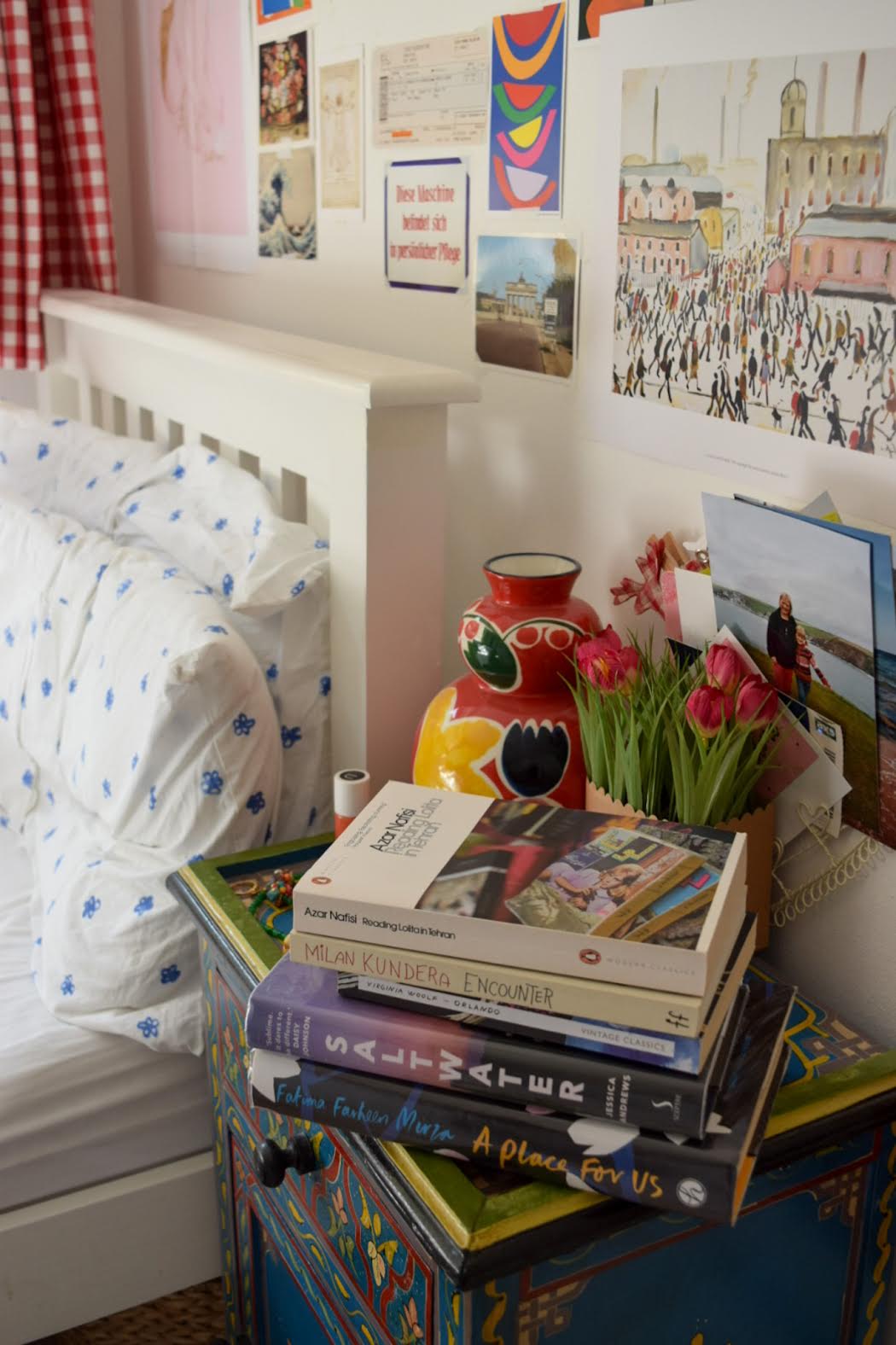
My new favourite hobby is going onto the hashtag of a book that someone has reviewed in order to find similar ‘bookstagrammers’; finding yet more books to add to the list of books I do not have the capacity to read, yet will attempt to nonetheless. My saved posts on Instagram, as well as the majority of my screenshots range from visually appealing art books to new contemporary fiction that has been no doubt recommended on the High Low. My copy of Exciting Times currently in the post is an exemplar of this literary fervour.
@betweentwobooks, a book club run by Florence, is deserved of a mention for reading inspiration. Yes, the Florence from Florence and the Machines; sharing reads on a different theme each week. My love for this account was merely cemented when Olivia Laing read from her latest book ‘Funny Weather, Art in An Emergency’. This is alongside @SendB00ks – their Instagram repeatedly churns out book inspiration and a desire for funky second-hand book covers through the shop. The personal touch of the account augments the charm, commissioning an artist every month to design a postcard that is sent out with the books. I could dedicate a post alone on where to find books, but here are a few of my own recommendations.

As a consequence of reading Lolita, a book I featured in my last recommendation post, I discovered Reading Lolita in Tehran by Azar Nafisi. Starting a literary group with seven of her students, Nafisi and the group read Western classics that forbidden in Tehran. This remarkable memoir gave me a constant sense of incredible pathos, yet it is ultimately a tale of great resilience. The novels that they read, also including The Great Gatsby and Pride and Prejudice (alongside other works from their respective authors), simply accentuate how books have such a power to transform worlds. The women go beyond the words of the writers they read, in turn sharing their own stories and backgrounds. If you’re looking for a memoir that has strength at its core, then this you will be thoroughly satisfied.

My second interaction with Milan Kundera did not disappoint. His essay collection Encounter seeks to illuminate several artists, writers and composers who aid him understand the world, helping to restore them to the greatness he feels they deserve. I went away from reading this book with a word document filled with further reading and information, in particular, the French writers and orators mentioned and a new perspective on what we mean when we classify someone as a greater writer, and perhaps what counts as their fall in one’s estimation of them.
There was one particular essay where he and a friend are both discussing Joseph Conrad. Both have differing views but they’ve both read different works by him. Are they still examining the same person? I think I loved how it made me question what I already understood about the power of literary works and their historical significance, as Kundera vehemently defends some writers and their corresponding works with respect to the present. It is by no means a light read and familiarity with who he was discussing would have helped but I came away with a knowledge of figures such as the French novelist Anatole France or the poet and politician Aimé Césaire that I would not have before. It goes without saying that I now have a list of books for further reading.

There is no perfect book for self-isolation but Virginia Woolf’s Orlando was a good bet in terms of escapism. I couldn’t help feeling that this was a novel beyond its time, as Woolf explores the nature of sexuality through the main character, Orlando. The plot follows Orlando as a boy in the Elizabethan period, who, after becoming an ambassador in Constantinople, awakes one morning as a woman. The rest of the novel, spanning both the Victorian era and the year that voting was made equal to both genders, 1928, sees Orlando remain as female.
Moving in both time and space as a witness to historic events. It is not particularly serious in the study of gender and parodies scenes from other literary texts such as Jane Eyre. I’ve not necessarily connected to Woolf’s writing before but I was struck by her incredible wit and attention to detail, understandable given that the novel was in part inspired by Woolf’s lover Vita Sackville-West. Sackville-West used to cross-dress, freedom inverted by Woolf within Orlando, who encounters restriction after experiencing freedom.

Recently, my desire to read more contemporary literature has increased, perhaps due to the relation I’d like to feel to the world pre-self-isolation. Saltwater by Jessica Andrews was one of these books. Having grown up in Sunderland, Lucy’s transition to London and the future that it holds, but equally doesn’t hold is at the heart of the plot, as well as her return to Ireland to seek solace in her late grandfather’s isolated cottage. The mother-daughter relationship explored perhaps touched me most and whilst I felt that her relationship with her brother wasn’t touched on more, I also feel that it added to the notion of isolation and shifting feelings of love within the book. The novel is a brilliant discussion of class identity as well, the feelings of feeling like an outsider in a world you’re fit for, but not for fitting in. If you’re a fan of Sally Rooney then this is definitely the book for you.
I’m not quite sure how I stumbled upon A Place for Us but I’m quite glad I did. While I didn’t love it, to begin with, I came to read it with such intensity that I read most of it in a day. The plot follows an Indian Muslim family as they prepare for the eldest daughter’s wedding, as the narrative alternates between different characters and periods of their lives, exploring the story of how their younger brother, Amar, becomes estranged from the family. The character development ! The tenderness ! The emotional attachment ! It was a beautiful exploration of what it means to be a modern American Muslim family. The last chapter of the book merits its appearance within this post. It was heartbreaking, tender and compounds the intense nature of family relationships.
Next up on my reading list are Leila Slimani’s Sex and Lies, Milan Kundera’s Immortality and Lorca’s A Poet in New York. Please send me your recommendations and let me know what you’ve been reading in this lockdown period; I am always ready to dive in for more literature.
lots of love, eleanor xx


Leave a Reply