
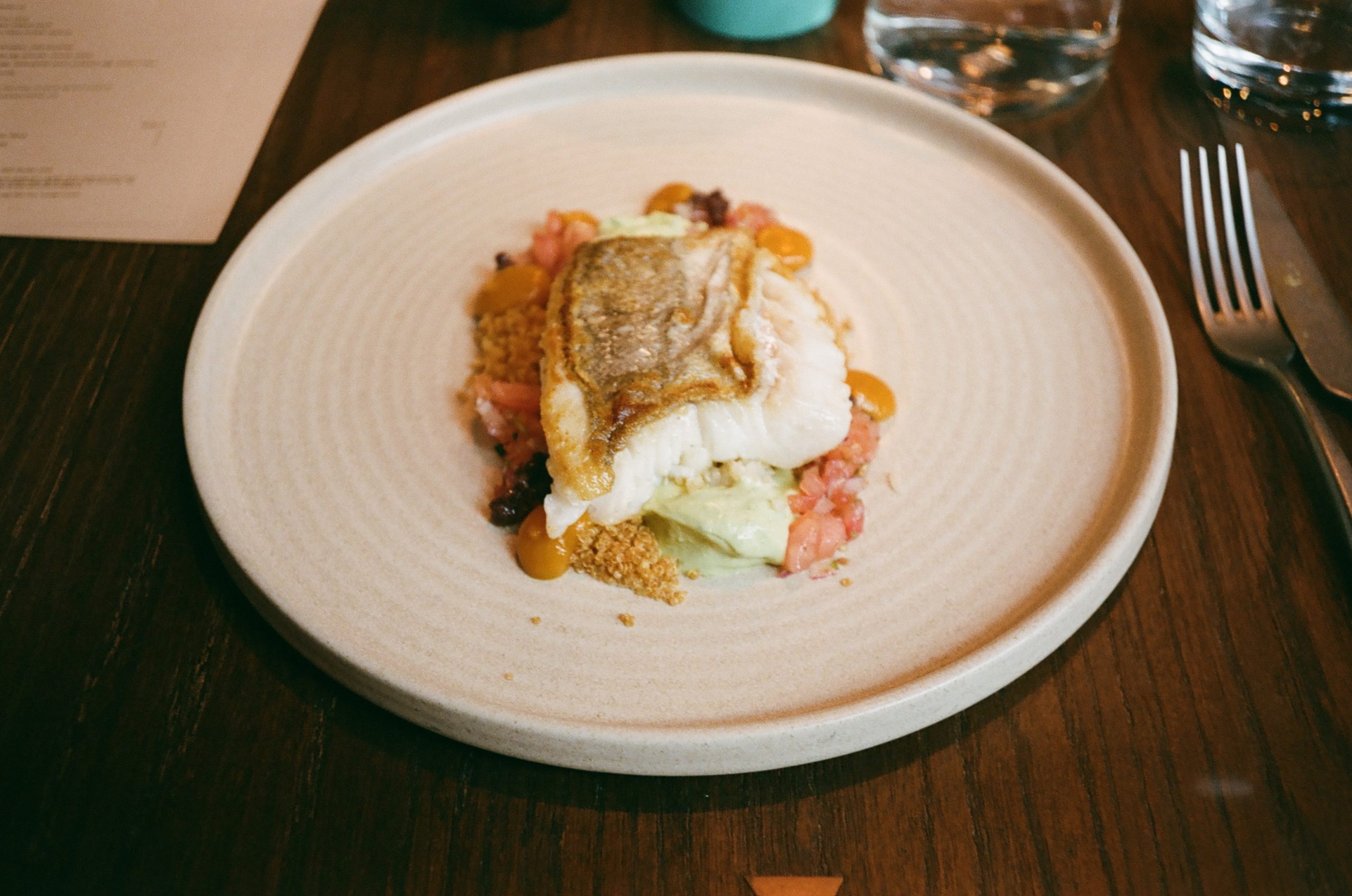
Whilst I was working at Miga, the family-run Korean restaurant in Hackney, last year, I struck up a conversation with a couple over one of my most beloved Chilean artists, Cecilia Vicuna. Like all brilliant conversations about food and art, they (Prenay Agarwal and his husband Benjamín Figari) mentioned the opening of their new restaurant, Mareida. This Chilean restaurant and wine bar tucked just off Great Portland Street. The impetus that a restaurant could centre Chile at the heart of not only the cuisine but also the architecture, art and interior: a cultural immersion that insists on displacing London’s disparate conglomerate of Latin American restaurants.
Writing up this interview has taken far too long, having met Mareida’s founder, Prenay Agarwal, at the restaurant in mid-July last year. The restaurant’s narrative, cuisine and visual storytelling has gone from strength to strength, with the latest art commission from Nicolás Radic, using overlapping colours and light as a metaphor for diversity. The idea that distinct identities, like ingredients in cooking, don’t lose themselves when they meet, but together create something entirely new ensures the piece firmly grounds itself within the restaurant’s identity.
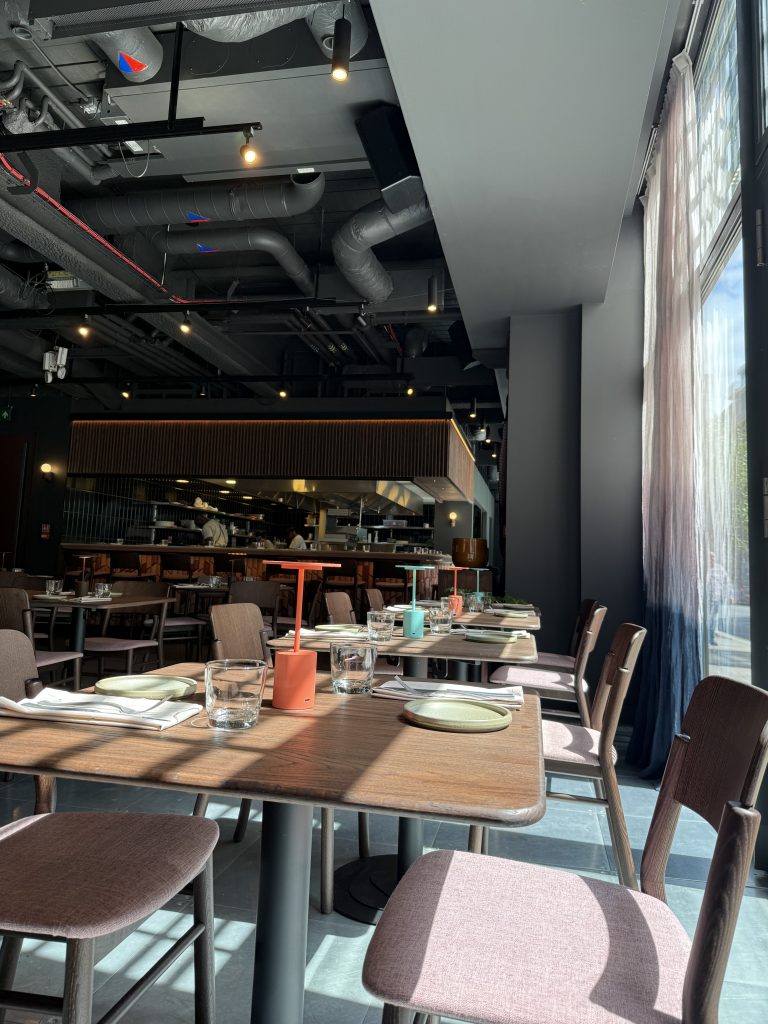
Mareida feels closer to a process-based practice: assembled collaboratively, layered, researched and continuously interpreted. The restaurant takes its name from Amereida, the Chilean poem that maps an imagined journey from the southern tip of the country northwards across the continent. That sense of traversal is embedded into the space: the coastline distilled into ‘mar,’ the Andes suggested in their hand-dyed curtain covering the length of the restaurant.
What struck me most during my visit was the refusal to isolate cuisine from its wider cultural matrix. The tables were made in Chile, inlaid with copper; the curtains were dyed by a Chilean fashion designer to evoke mountainous topographies; outside, a lightbox installation references the glacial blues of Patagonia. The restaurant becomes less an interior and more a curated terrain: a mapping exercise of the Andean South in central London. The space was carefully designed by Macarena Aguilar Izquierdo of Santiago-based studio DAW, with almost every material sourced and made in Chile before being shipped to London. The bar, made in collaboration with Chilean architect Mále Uribe, is faced in tiles pressed from mining waste: Combarbalite powder, quartz and copper tailings formed into a geometric, Andean-textured relief.
Led by head chef, Nico Einersen, Mareida’s dishes draw on traditional Chilean recipes, offering modern adaptations all while prioritising responsible ingredients. The menu acknowledges Chile’s immediate neighbours, Peru, Bolivia, Argentina, without collapsing them into a singular Latin American shorthand. Instead, it insists on geographic and cultural specificity.
London’s dining landscape has, for years, embraced Peruvian and Mexican cuisine, often flattening the continent into a convenient culinary category. Mareida quietly resists this compression. It performs a kind of cultural restoration: insisting that Chile be understood not only through flavour but through poetry, design, material culture and storytelling.
Mareida does not simply serve dishes from Chile; it stages Chile as a living, evolving ecology. And in doing so, it expands what a restaurant in London can be: not a theme, nor a viral trend, but a carefully constructed conversation between place and plate.
The first challenge must have been how to create a modern brand to represent Chile to a global audience. How did you approach that?
We worked with Constanza Gaggero, who is one of Chile’s leading designers. She has had projects shown at Museum of Modern Art and Tate, and she designs pavilions at the Venice Biennale.
She helped us develop Mareida as an umbrella brand. The idea was always to create something that could house different concepts under one name.
The name itself was suggested by our architect. There’s a Chilean poem called Amereida, about a journey from the southern tip of Chile, from Punta Arenas, all the way to Bolivia, crossing the country. It felt like a beautiful narrative for what we were trying to do. We also wanted to reference the coastline, so we incorporated “mar” (sea). It became an evolution of Amereida: combining ideas, just as the original word combines “America” and “Aeneid.” That’s how Mareida came about.
Connie produced a 200-page research document exploring Chilean colours, landscapes and palettes. The typeface is inspired by hand-painted signs in Chilean markets. And the triangle in the logo, referencing the country’s location within the Lithium Triangle, the geographic region that holds the majority of the earth’s salt supply. Sometimes it’s rendered in copper to reference Chile’s mining industry; sometimes in blue to evoke the ocean. It’s something minimal that can be interpreted in multiple ways.
How did you narrow down the artists and architect for the space?
It happened very organically. I was having lunch at the beach in Chile over New Year and happened to sit next to the architect. She asked what I was working on, and I mentioned we were thinking of opening a Chilean restaurant. She specialises in restaurant design, and she also sits on the board of an art foundation in Chile called Antenna.
She guided the overall design direction and the selection of artists involved in the project. Almost everything you see here connects back to Chile. The tables were made in Chile, with the logo inlaid in copper. The curtains were made by Chilean fashion designer Sisa and hand-dyed to create a mountain effect: referencing the Andes when they’re drawn closed.
What do you see as the link between Chilean food and Chilean art, culture and design?
One of my biggest learnings from this project is that no one had really brought everything together in this way before. That’s why there was so much energy around it. We suddenly had this incredible space in central London to showcase Chilean creativity.
Chileans can be quite understated. They do extraordinary things, but there’s often a quietness about it. Geographically, Chile is protected by the Andes and the Pacific Ocean, two enormous natural barriers. Perhaps because of that, there hasn’t been as much external interpretation of Chilean culture within hospitality.
I think we’re among the first to make that link so explicitly.
For someone unfamiliar with Chilean culture, is there a book, film or dish you’d recommend?
In literature, you’d naturally turn to Pablo Neruda or Gabriela Mistral. The poem Amereida is also significant in terms of cultural imagination.
In film, there’s a documentary called Chile Estyle, exploring graffiti and music in Chile. Interestingly, the DJ who produced Mareida’s soundtrack, RAF, also worked on that film.
In terms of food, our most iconic dish is pastel de choclo: a traditional corn pie layered with meat, corn and other fillings. It’s homely and comforting, probably the first dish many people associate with Chilean cuisine. We do a slight twist and use lamb instead of beef, just to reinterpret it slightly.
What’s your personal favourite Chilean dish? And what do you like to cook at home?
My favourite dish on the menu is chupe de jaiba: a Chilean crab pie. It’s a very hearty crab stew mixed with bread, cheese and lots of crab meat. It’s warm, comforting and deeply satisfying.
At home, I lived in Italy for six years, so I often cook Mediterranean food. I focus on good-quality ingredients, simple pasta dishes, salads, grilled fish. I also enjoy experimenting with recipes from different countries using a Thermomix. It has a global digital library, so you can try dishes from all over the world.
Who is your favourite visual artist?
That’s a difficult question. Recently, I’ve been surrounded by Chilean artists because our house is full of Chilean art.
One artist I really admire is Javier Toro Blum. He created the large lightbox installation outside Mareida. He makes portal-like light works that reference celestial bodies and stars. The piece outside of the restaurant is the largest he’s made, titled Portal Astra, meaning portal to the southern world.
The inspiration comes from looking deep into glaciers: that intense blackness with layered shades of blue. I love how his work combines technology and atmosphere in such a poetic way.
What do you think about the current state of Latin American cuisine in London, and where do you see it heading?
I think there needs to be an important education around the difference between the geographies, because I think people sort of bucket South America into one category, whereas it is so diverse and interesting.
I think the food scene in London is often focused on Peruvian food or Mexican. There’s so much to explore in terms of Bolivian or Colombian cuisine. So I think there’s some really strong concepts, but I think very rarely do they go into the details of working with like art and culture. The storytelling hasn’t been thought out so much. I guess it also depends how much people actually care, because you need to balance. For us, there was a lot of responsibility in representing Chile, so that’s why we took the time to really go deep into the details.
—
Find Mareida at 160 Great Portland St, London W1W 5QA
Leave a Reply